
Sparsity-Oriented 4D Automotive Radar Sensing: Sparse Array and Waveform Design, Processing, and Model-Based Learning

About this Topic:
Four-dimensional (4D) automotive radar has emerged as a key sensing modality for autonomous vehicles, providing range, Doppler, azimuth, and elevation information robust under adverse weather and lighting conditions. High-resolution direction-of-arrival (DOA) estimation is the defining capability separating 4D imaging radar from conventional automotive radar, yet must be achieved under stringent constraints on cost, aperture, snapshots, and quantization.
This webinar revisits and extends our IEEE J-STSP article, "4D Automotive Radar Sensing for Autonomous Vehicles: A Sparsity-Oriented Approach," tracing the evolution from sparsity-oriented design to model-based learning for angle estimation. The first part addresses sparsity-based design and processing: how sparse arrays enlarge the virtual aperture with far fewer radio-frequency chains, while multi-frequency sparse arrays, sparse waveform design, and waveform partitioning further enhance DOA estimation and MIMO efficiency. The second part turns to learning-based processing: model-based deep learning for DOA estimation, in which array signal models are embedded into neural architectures (e.g., algorithm unrolling) to combine model-based interpretability and data efficiency with data-driven performance. We highlight 1-bit deep-learning-based DOA estimation under coarse quantization and recent results for automotive radar, linking better angle estimation to denser point clouds and perception.
The talk concludes with open challenges across sparse sensing, signal processing, and machine learning.
About the Presenters:
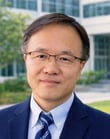
Shunqiao Sun received the Ph.D. degree in electrical and computer engineering from Rutgers, The State University of New Jersey, New Brunswick, NJ, USA, in January 2016.
He is currently an Assistant Professor with the Department of Electrical and Computer Engineering at The University of Alabama, where he joined in August 2019, and will be promoted to an Associate Professor effective August 2026. From 2016 to 2019, he was a Radar Signal Processing Engineer with Aptiv, Technical Center Malibu, Agoura Hills, CA, USA, where he worked on advanced radar signal processing and machine learning algorithms for self-driving vehicles and led the development of direction-of-arrival estimation techniques for next-generation short-range radar sensors deployed in more than 120 million production vehicles. His research lies at the intersection of RF sensing systems, applied electromagnetics, array and statistical signal processing, and physics-guided machine learning, with applications to automotive radar, MIMO radar, autonomous systems, resilient perception in complex environments, and radar-centric sensing for Physical AI.
Dr. Sun received the U.S. National Science Foundation (NSF) CAREER Award in 2024 and the NSF CRII Award in 2022. He received the 2016 IEEE Aerospace and Electronic Systems Society Robert T. Hill Best Dissertation Award for his dissertation “MIMO Radar with Sparse Sensing,” and coauthored a paper that received the Best Student Paper Award at the 2020 IEEE Sensor Array and Multichannel Signal Processing Workshop (SAM). He is an invited plenary speaker at SAM 2026. He is currently Chair of the IEEE Signal Processing Society (SPS) Autonomous Systems Initiative (ASI) for 2026–2027, after serving as Vice Chair from 2023 to 2025. He is an elected member of the IEEE Sensor Array and Multichannel Technical Committee (2024–2026) and the IEEE SPS Integrated Sensing and Communication Technical Working Group (2025–2027). He has co-organized the Signal Processing for Autonomous Systems (SPAS) workshops at ICASSP 2023, ICASSP 2024, and EUSIPCO 2025, as well as numerous special sessions on automotive radar signal processing, machine learning, and sparse arrays at IEEE SPS and AESS flagship conferences. He is an Associate Editor for the IEEE Transactions on Aerospace and Electronic Systems, IEEE Transactions on Vehicular Technology, and IEEE Signal Processing Letters. He is a Senior Member of IEEE.
Yimin D. Zhang (F’19) received the degree from the Northwest Telecommunications Engineering Institute (now Xidian University) and the M.Sc. and Ph.D. degrees in engineering from the University of Tsukuba, Japan, in 1982, 1985 & 1988 respectively.
He is currently a Professor at the Department of Electrical and Computer Engineering, Temple University, Philadelphia, PA. His research interests are in the areas of statistical signal and array processing, compressive sensing, machine learning, information theory, convex optimization, computational imaging, and time-frequency analysis, with applications to radar sensing, wireless communications, satellite navigation, and radio astronomy.
Dr. Zhang publications include 450 journal and conference papers, 20 book chapters, and two co-edited books, Information-Theoretic Radar Signal Processing and Machine Learning for Radar Signal Processing, both published from Wiley-IEEE Press. His publications received the 2018 and 2021 IEEE Signal Processing Society (SPS) Young Author Best Paper Awards, the 2016 IET Radar, Sonar & Navigation Premium Award, the 2017 IEEE Aerospace and Electronic Systems Society (AESS) Mimno Award, the 2019 IET Communications Premium Award, and the 2021 EURASIP Best Paper Award for Signal Processing. He also received the 2024 Outstanding Editorial Board Member Award from IEEE Signal Processing Society for his outstanding editorial board service for the IEEE Transactions on Signal Processing and was selected as an IEEE Signal Processing Society Distinguisher Lecturer in 2024. Dr. Zhang is a Fellow of EURASIP and a Fellow of SPIE. He is a member of the IEEE Signal Processing Society's Sensor Array and Multichannel (SAM) Technical Committee and a member of EURASIP Signal Processing for Multisensor Systems (SPMuS) Technical Area Committee.
Want to learn more about upcoming events & webinars?
Visit the events section of the Signal Processing website to see all upcoming lectures, workshops, webinars, and more.